

Teeth play one of the most important roles in our lives. They are not only multifunctional but also have a direct impact on our overall health. Over time, for various reasons, the quality and number of teeth can decrease significantly. What should be done in such cases? There are two main solutions: traditional removable dentures and modern dental implants. Let’s take a closer look at what dental implantation is and when it is necessary.
What Is a Dental Implant?
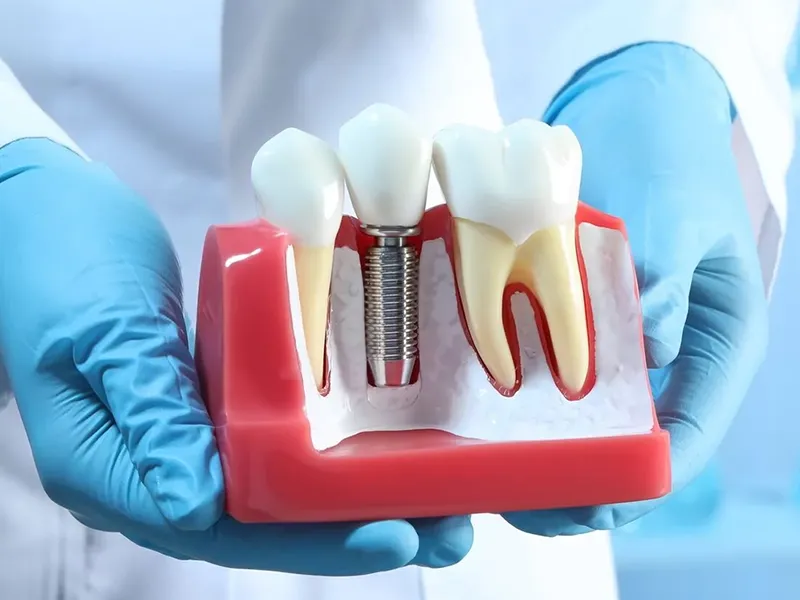
When a tooth root is completely missing, an artificial replacement, known as a dental implant, comes to the rescue. A dental implant is a titanium structure consisting of 3 main parts:
- Implant fixture — a screw-shaped structure approximately 8–19 mm in length and 3.5–5 mm in diameter, which is placed into the jawbone. Through the process of osseointegration, it functions as a natural tooth root.
- Abutment — a connecting element attached to the implant fixture, providing the link between the implant and the restored tooth.
- Crown (micro prosthesis) — the visible part of the implant-supported restoration, which is fixed onto the abutment and restores the tooth’s natural appearance, shape, and function.
As a result, dental implantation effectively addresses several important issues at once: restoring the integrity of the dental arch, rebuilding proper chewing function, and achieving a flawless smile.
Advantages of Dental Implantation
Millions of patients worldwide who have chosen dental implants are satisfied with the results, as this procedure offers many benefits. Let’s take a look at some of the key advantages:
- Aesthetics: Dental implants are virtually indistinguishable from natural teeth in both shape and color.
- Flexible placement: Any number of dental implants can be placed, and the presence or absence of neighboring teeth is not an obstacle.
- Reliable fixation: Implants allow you to chew any type of food without restrictions. They remain stable and do not shift while eating or speaking.
- Durability: Manufacturers often offer a lifetime warranty on implants. After 20–25 years, only the prosthetic crowns may need to be replaced.
- Comfort: Implants are not felt in the mouth, do not produce odors, do not affect taste, and do not enter into chemical reactions.
- Preservation of bone tissue: Implants provide an optimal level of load on the jawbone, preventing bone atrophy and slowing facial aging.
- Hygiene: Dental implants are cared for in the same way as natural teeth: regular brushing and flossing, along with routine dental check-ups.
When dental implantation is not recommended and what the alternatives are?
Despite its many advantages, there are situations in which dental implantation is not possible. Contraindications can be divided into two types:
- Absolute: hypocoagulation, diabetes mellitus, osteoporosis, autoimmune diseases in which surgical intervention carries a high risk.
- Relative (temporary): smoking, cardiovascular diseases, cancer, bite (occlusion) disorders, and others.
As for age restrictions, dental implantation is not permitted before the age of 18 and is generally not recommended after the age of 70. What options are available in these situations? The dentist evaluates the patient’s overall condition, diagnoses any issues, and selects the most appropriate treatment method. If dental implantation is not an option, alternative solutions are recommended, such as removable dentures or fixed bridges (zirconia or metal-ceramic). In some cases, missing teeth can be replaced by repositioning neighboring teeth using braces.
How Dental Implantation Is Performed
Would you like to know what to expect if you are indicated for dental implantation? You will go through several stages:
• Preparatory stage: examination, X-rays, and CT scanning.
• Orthopedic stage: the abutment and dental crowns.
• Surgical stage: the implant.
• And, of course, the rehabilitation stage: aftercare and follow-up.
Today, there are two main approaches to dental implantation: the classic two-stage method and the innovative one-stage method (express implantation or “All-on-4”). The method chosen, the number of stages, and the duration of the procedures are determined individually by the implantologist for each specific case.
How much do dental implants cost in Armenia?
Want to know the cost of a dental implant? Prices can vary widely. The final cost depends on many factors, including the manufacturer (Straumann, Nobel Biocare, or MIS), the material, the type of crown, the number of treatment stages, and any additional procedures such as bone grafting, sinus lifting, or anesthesia, etc.
At the Perfect Smile dental clinic, the price of a single dental implant starts from 120,000 AMD. The total cost of dental implantation is determined after a consultation with an implantologist and the development of an individualized treatment plan.